Wednesday, July 31, 2024

Literature I've Loved (after the NYT list)

I began compiling this list because whenever I teach, I'm always scouting out works I can include on the syllabus and I'm slated to teach a course this Fall. But I decided to complete it after the fanfare that resulted from The New York Times' list. Note, I don't make temporal distinctions. These are the works from all time that move me, which I suppose might be off-topic since the newspaper was specifically aiming to capture the best books of this century. I am not convinced -- or maybe I'm simply unsure -- the best books  I've read were published during the current century. I also approach my reading life in a way that's quite separate from the publishing industry's calendar. I have recommendations from friends, I have genres I follow (memoir, literature by Italian women authors), I have gaps to fill (Shakespeare! Toni Morrison!), and none of that necessarily coincides with the particular books that come out each year (the most notable often go on the TBR file, no?). 

To be sure, many of these works I've read and/or re-read this century. But does that matter? Let's put the issue aside and move onto the actual list, which isn't exhaustive, more like 'some ideas' for what to read. A list like this could really go on and on but I'm going to call time right now. And I've probably missed all kinds of books that I loved. Oh well!

Fiction
The Dubliners, James Joyce
Drown, Junot Diaz (which I preferred to 'Oscar Wao,' which made the Times' list)
The Divine Comedy, Dante (definitely not this century, ha ha!)
Love in the Time of Cholera, Gabriel Garcia Marquez
The Great Gatsby, F. Scott Fitzgerald
This Darkness Will Never End, by Edith Bruck (note, my translation) UPDATE!!!!
Their Eyes Were Watching God, Zora Neale Hurston
Il Giorno della Civetta, Leonardo Sciascia
To Each His Own (A Ciascuno Il Suo), Leonardo Sciascia
Days of Abandonment, Elena Ferrante
The Garden of the Finzi-Continis (Il Giardino dei Finzi-Contini)
Lost in the City, Edward P. Jones (His book, "The Known World," is on the NYT list but I haven't read it yet!) (almost this century!)
Country Girls, Edna O'Brien (May she rest in peace!)
A Month in the Country, J.L. Carr 
A Meal in Winter, Hubert Mingarelli
Gli Indifferenti, Alberto Moravia
The Bishop's Bedroom, Piero Chiara (in a stellar translation by Jill Foulston)
Long Day's Journey into Night, Eugene O'Neill
So You Don't Get Lost in the Neighborhood, Patrick Modiano (actually this century)
Suspended Sentences (ibid)
A Scrap of Time, Ida Fink (see below)
Charming Billy, Alice McDermott
What We Talk About When We Talk About Love, Raymond Carver 
Night Boat to Tangier by Kevin Barry (this century)
If You Kept A Record of Sins, Andrea Bajani (ditto) (and translated gloriously by Elizabeth Harris)
Great Expectations, Charles Dickens (thanks to my friend, Jenny, for reminding me of this incredible book! So this entry is an addition to the original list, judges)

Essays/Memoir
"Notes of a Native Son" by James Baldwin
"My Alma Mater is Auschwitz," by Edith Bruck (note, my translation)
"Journey into Night" by David Sedaris
"Black Men and Public Space" Brent Staples
"Going it Alone" by Rahawa Haile
"Winter in Abruzzo" by Natalia Ginzburg
“Mother Tongue” by Amy Tan 
"The Namesake" by Mason Stokes
"Brownsville Kitchen" by Alfred Kazin
“No Name Woman” by Maxine Hong Kingston 
"We Should All Be Feminists" by Chimamanda Ngozi Adichie

Nonfiction (book-length)
The Fire Next Time, James Baldwin
If This is a Man, Primo Levi
Dora Bruder, Patrick Modiano
A Small Place, Jamaica Kincaid
The Periodic Table, Primo Levi
Wanderlust. Rebecca Solnit (it's about WALKING! Walking!)
Kitchen Confidential, Anthony Bourdain
Family Lexicon ("Lessico Famigliare")
"Trial by Fire," by David Grann (in The New Yorker)
The Letters of Nancy Mitford
Aran Islands, Synge (definitely not this century, ha ha!)
Here in Our Auschwitz, Tadeusz Borowski 


Individual short stories
"The Haircut" by Ring Lardner
"Making Love" by Antonya Nelson
"Casta Diva" by Francesca Scotti
"Autumn Lessons" by F. Marzia Esposito (read my translation of it here!)
"Cortez Island" by Alice Munro
"Your Husband is Cheating on Us"
"The Dead," Joyce, just in case you can only read one story from Dubliners
"A Hand Reached Down..." David Gates
"The Key Game" by Ida Fink (click on link but it's devastating)
“Girl” by Jamaica Kincaid
“In the Cemetery Where Al Jolson Is Buried,” by Amy Hempel

Poetry
"Now" by Denis Johnson
"Aubade" by Philip Larkin
"Rime of the Ancient Mariner"
"The Man He Killed" by Thomas Hardy (a poem I learned by heart as a girl -- yes I can still recite it. It's short!)
"The House," Warsan Shire
"The Second Coming," by Yeats
"Digging," by Seamus Heaney
"The Symbol," "To Be Born By Chance" and "Maybe," by Edith Bruck (note, my translation)

Graphic novel
Maus, Art Spiegelman
Fun Home, Alison Bechdel

In Italian, not available in translation
Viaggi e altri viaggi, Antonio Tabucchi (English translation forthcoming)
Andremo in Città by Edith Bruck, not yet available in translation BUT SOON! SOON!
Due Stanze Vuote(note, the (my) English translation could be available! Read an excerpt here)
Passaggio in ombra (note, the (my) English translation could be available! Read an excerpt here)

(Yes, forgive me, I've included links to some of my translations because as a part-time translator, I only translate what moves me)

Tell me the literature you've loved. Don't worry about which century had the luck of seeing it published.

-30-

Saturday, July 06, 2024

What I read before leaving for Ireland: Gente di Dublino

Italian literature is never far from my mind, even during the last few months when I immersed myself in Irish literature as I prepared for my first trip to Ireland in more than a decade. 

It's perhaps because when I read Italian literature, I attempt to fill in the vast gaps in my education, seeing as I attended school in America, and not Italy. So many Italian classics I naturally didn't encounter in high school!

As such, I've avoided reading American or British classics in Italian. Why bother?

But a year or so ago, I stumbled over the opening lines of The Great Gatsby in Italian. By which, I mean, the first lines of IL GRANDE GATSBY. (I wrote about it here). 

It happens to be my favorite novel of all time. And I realized how tickled I would be to see how the Italians render it (tickled and maybe also edified, since I do some literary translation, myself).

And why stop there?

So when Il Nostro Inviato (Mike) went to Italy a few months ago for work, rather than ask for the latest releases from my favorite Italian women writers (my standard order), I asked for Gente di Dublino.

Or what I've been calling "Dubliners" since I read it for the first time at St. Anthony's High School on Long Island.

I made a beeline for the masterpiece of James Joyce's collection, "The Dead," or in Italian, "I morti."

Here are the indelible final lines from that seminal story (slightly condensed):

(From "I morti" -- "The Dead")

"Cadeva la neve in ogni parte della scura pianura centrale ... E cadeva anche su ogni punto del solitario cimitero sulla collina in cui giaceva il corpo di Michael Furey.

"...pian piano l'anima gli svaní lenta mentre udiva la neve cadere stancamente su tutto l'universo e stancamente cadere, come la discesa della loro fine ultima, su tutti i vivi e tutti i morti."

I can remember my teacher, Brother Jeffrey, pointing out the repetition in the lines: "falling faintly through the universe and faintly falling," and they delight in Italian, too. (In my head, I still hear the main character's name, Gabriel Conroy, in Brother Jeff's voice).

I've been binge-reading Irish literature for months -- ever since booking our trip to Ireland shortly before St. Patrick's Day.

And I've spent my reading hours re-visiting Synge and other works by Joyce, as well as tackling several Brendan Behan works and a short play by Samuel Beckett.

But there's really nothing like those final lines of "The Dead" or "I morti." It's the same, really, in the end. Be it, "The descent of their last end," or "La discesa della loro fine ultima," great literature is enthralling.

(Update for 2026: I taught Dubliners for the first time in the Fall as part of a writing course at Wesleyan on Fiction and Nonfiction, and that was a thrill! To revisit all of these characters -- Little Chandler, Mr. Duffy, Mrs. Sinico, Michael Furey, Gretta, and, of course, Gabriel Conroy, was nothing short of stepping into a time machine because some of my students were reading it for the first time and I could remember how I felt when I did just that).
-30-

Monday, April 15, 2024

Jeanne reads poems by Edith Bruck in translation

These are poems from Versi Vissuti, which combines three of Edith's poetry collections. I read them for the translation reading series, Translators Aloud, which is a YouTube channel that bills itself The Voice of Translated Literature.

Enjoy!


Thursday, March 07, 2024

An Oscar-winning film, seen on a whim, changed my life


I don’t pay much attention to the Oscars ceremony, which will air on Sunday. Most years, I don’t see a single movie that’s been nominated. “Barbie?” Haven’t seen it. “Oppenheimer”? Nope. I’m a middle-aged mother with an 11-year-old son so I see few movies expressly for adults.

But once upon a time, an Oscar nod was reason enough for me to go to the movies. Ten days before leaving for college at Wesleyan University, I saw what's now considered a modern Italian classic: “Cinema Paradiso.” It won the 1989 Oscar for best foreign film -- and it changed my life.

The main character is a famous movie director named Totò who revisits the tiny Sicilian town where he grew up in the years following World War II. The film begins in the present day, in an apartment in Rome, but an unexpected phone call sends the director back to Sicily – and the movie back in time.

In the director’s boyhood village, life revolves around the parish church and the lone movie theater. That’s where the whole town convenes in the years before television. Alfredo, the projectionist, is seen repeatedly shooing away Totò – back when he’s an adorable but incorrigible boy who is infatuated with movies and always grabbing strips of film that fall on the floor. Alfredo eventually relents and agrees to teach him his profession. In the course of the film, Totò transforms from a tiny tot who uses a stepstool to reach the projector into a teen using his first movie camera to capture frames of a pretty girl he likes.

Before I saw the film, I knew no Italian, and had no plans to study the language. But when I arrived at college a short while later, I enrolled in Italian 101 and signed up for a hybrid literature program that included a semester abroad – all because I fell in love with the sounds I’d heard in the film. Eighteen months later, I left to study in Italy, and after college, I went back to live in Tuscany as an ex-pat. Since returning to the States, I’ve written this blog as an ode to small Italian pleasures. The film is one of many reasons a part of me will forever remain in Italy.

The movie does what all good fiction does: it makes you wish you lived in the world evoked by the story, in this case, Italian small-town life. I felt as though I had gone on vacation, to another country and another time. 

It also reminds me of the necessity of pursuing something that’s not inherently useful or handy. Knowing Italian won’t really get you out of a jam. Even traveling the world, you’ll find Italian will help you in only a handful of places outside of one solitary country (Italy). But studying Italian has been the great passion of my life; it’s allowed me to step inside the mind of another culture and revel in small moments, such as eavesdropping on a conversation between a barista and a regular at café in Rome or dining in a remote countryside restaurant where not a single other person speaks my native language. Fluency, after all, is a form of immersion not unlike diving into a pool.

I saw the film at a now-defunct arthouse cinema in Manhattan. Last year, I watched it with my students at a small college in Hartford where I was teaching Italian. I sat in the back of our darkened classroom, and took notes, my eyes brimming with tears of nostalgia. In one scene, Totò is at home in his kitchen pretending to be a cowboy, mimicking shoot-outs from westerns he’s watched at the theater. A lighthearted moment fraught with the knowledge that his father went off to war and never returns. In the space created by that absence, Totò’s friendship with Alfredo, who is childless, looms far larger than the token love story in the movie. 

Beyond recounting how a boy grows up to be a director, the film is about how longing and loss shape our lives, as well as the power of community. Totò leaves his provincial hometown on Alfredo’s advice, without ever looking back, and becomes successful in the big city. But the cost to both men is considerable. On his return, he sees what’s happened to the village – and his one-time mentor, Alfredo – since then. As the director revisits landmarks of his youth, he realizes he’s abandoned the people who loved him the most.

Watching the film at 18, I absorbed a culture completely foreign to my suburban New York upbringing. It drove me to master Italian so I could understand bits of dialogue that escaped me on the first viewing and it introduced me to what would become my adopted country. Since then, its language and customs have infiltrated every corner of my life. That 11-year-old son I mentioned? His name is Leonardo, and one afternoon in Italy not too long ago, a Florentine friend of mine insisted on teaching him to curse in Italian. I am raising him in a house where Italian words cover every surface, from book covers to the posters on the living room wall, and packages of breakfast biscotti in the pantry. 

So go to the movies. See a film you know nothing about. It might change your life. And one day, when he’s a little older, I’ll watch “Cinema Paradiso” with Leonardo – in the hopes that he, too, falls in love. With the movie, or movie-making, or even Italian. As long as he knows the beauty of falling in love with something powerful enough to change your life.

 -30-


Saturday, January 27, 2024

Women Holocaust survivors: A Reading List

To mark International Holocaust Remembrance Day (Jan. 27), below you'll find all the books I have read or want to read by or about women who survived the Holocaust. Note, this list is NOT exhaustive!  Mainly Italian authors, for starters. But a good primer on works involving a group of survivors that has often been marginalized, as I wrote in an article for the American Scholar last year. 

Available in translation (UPDATED!)

This Darkness Will Never EndEdith Bruck (Paul Dry Books) (Note, this is my translation)

Who Loves You Like This, Edith Bruck (Paul Dry Books; Thomas Kelso, translator)

Lost Bread, Edith Bruck (Ibid., Gabriella Romani and David Yanoff, translators)

Letter to My Mother, Edith Bruck (Brenda Webster and Gabriella Romani, translators)

There's a Place on Earth, Giuliana Tedeschi, (Tim Parks, translator)

Sentenced to Live, A Survivor's Memoir, Cecilie Klein

Ravensbrück, The Women's Camp of DeathDenise Dufournier

Smoke Over Birkenau, by Liana Millu, translated by Lynne Sharon Schwartz 

Auschwitz and After by Charlotte Delbo (French resistance fighter)

A Scrap of Time, Ida Fink (a collection of stories that includes "The Key Game" -- devastating)

Distant Fathers, Marina Jarre (click to read my reviews of both Jarre titles)

Return to Latvia, Marina Jarre (both Jarre books were translated by Ann Goldstein)

*Women in the Holocaust, edited by Dalia Ofer and Lenore J. Weitzman (I cited this book in the article I published in the American Scholar about women Holocaust survivors)

Not available in English translation

L'esile filo della memoria, Lidia Beccaria Rolfi (This book begins a few days before the writer was liberated from the concentration camp called Ravensbruck, which is fascinating because it deals with the saga of afterward. As if the saga of before -- the camps -- weren't enough.)

Come una rana d'inverno: Conversazioni con tre donne sopravvissute ad Auschwitz, Daniela Padoan (interviews with three women who survived the Holocaust) 

Il silenzio dei vivi, Elisa Springer

Due Stanze Vuote, Edith Bruck (Note, I'm translating this, thanks to an NEA grant; you can read an excerpt here, published by Jewish Currents magazine)

Transit, Edith Bruck

Lettera da FrancoforteEdith Bruck

Signora Auschwitz, Edith Bruck

Tagebuch, Liana Millu

Ricordi della casa dei morti, Luciana Nissim Momigliano

Scolpitelo nel vostro cuore, Liliana Segre

-30-

Wednesday, January 24, 2024

My Tiny Love Story in The New York Times

I've written a tiny love story for The New York Times and I think I'd like to compose one for everyone I've ever loved!

But I started with my first best friend, and it's a pretty good place to start.

World, this is my sister, Denise!

Coming to my rescue -- not for the first time.

The words came to me one day while I was taking a walk. That's so often how writing works, and in this case, since it's only 100 words, the few lines that might surface while out and about suffice!

What a thrill to have these particular words published in The New York Times, our childhood newspaper and one that I've had the privilege to write for a few times (including a piece that featured an audio snippet of Leo and me talking).

We've had a two-year period of losses, but as monumental as those events were, little moments and gestures can often be decisive. Little moments that act like life boats.

To read the entry properly, click on the photo above or click here.

-30-


Tuesday, January 16, 2024

Ryan Holiday: These 38 Reading Rules Changed My Life

I don't agree with all of them, but I do find this list (link below) of 'reading rules' intriguing, and I agree with the author (Ryan Holiday) that any aim at reading well, widely and frequently can benefit from a strategy.

The rules I agree with:

–"Do it all the time. Bring a book with you everywhere. I’ve read at the Grammy’s and in the moments before going under for a surgery. I’ve read on planes and beaches, in cars and in cars while I waited for a tow truck. You take the pockets of time you can get."

–"In every book you read, try to find your next one in its footnotes or bibliography. This is how you build a knowledge base in a subject—it’s how you trace a subject back to its core."

–"Don’t just read books, re-read books. There’s a great line the Stoics loved—that we never step in the same river twice. The books don’t change, but you do."

Read more here:

https://ryanholiday.net/these-38-reading-rules-changed-my-life/

Wednesday, January 10, 2024

First line of "The Great Gatsby" -- in Italian

One day, for no particular reason, I decided I absolutely had to know the opening lines of the Italian version of my favorite novel – and I needed to record it somewhere … here, of course. So without further ado, I give you F. Scott Fitzgerald in Italian:

Negli anni più vulnerabili della giovinezza, mio padre mi diede un consiglio che non mi è mai più uscito di mente. "Quando ti viene voglia di criticare qualcuno," mi disse, "ricordati che non tutti a questo mondo hanno avuto i vantaggi che hai avuto tu."

Which in English is:

In my younger and more vulnerable years, my father gave me some advice that I've been turning over in my mind ever since.

"Whenever you feel like criticizing anyone," he told me, "just remember that all the people in this world haven't had the advantages that you've had."

-30-

Wednesday, January 03, 2024

Happy heavenly birthday, Mariateresa Di Lascia!

Today is the birthday of Italian author and parliamentarian Mariateresa Di Lascia -- she would have been 69. She died in 1994 after writing a few short stories and completing a lone novel.

I encountered her work when I was commissioned to write an article for the Literary Hub site about Italian novels that hadn't been translated into English yet -- but should be. 

The novel, Passaggio in Ombra (my English title: "Into the Shadows") is a coming-of-age work that is one of many books to light the way for Elena Ferrante (both authors featuring women narrators bucking convention). As I've written before, Di Lascia’s novel analyzes and exalts the interior lives of a group of women buffeted by their limited choices, their unruly desire for freedom and the price they pay for these desires (something anyone suffering from #Ferrantefever would understand).

I won a $5,000 grant from PEN America to jumpstart my translation work on the manuscript. Unfortunately it has yet to find a publisher. You can read an excerpt of my translation here.

One of the lines I love best isn't in this excerpt and is about the narrator's father:

"When he thought about how his life would turn out, what form it would take if indeed it would ever bend itself to a specific shape, he felt something inside of him rebel. As if it would be an unbearable imposition. In those days, he had one lone desire: to preserve for as long as he could -- maybe even forever -- the freedom to have no direction of any kind."

I've had to put her work aside because I have an NEA translation grant to work on selected short stories by Edith Bruck. But one day, I will return to the Di Lascia manuscript one day and I hope to publish it. 

-30-

Friday, December 29, 2023

Montreal Journal & the joys of travel in 2023

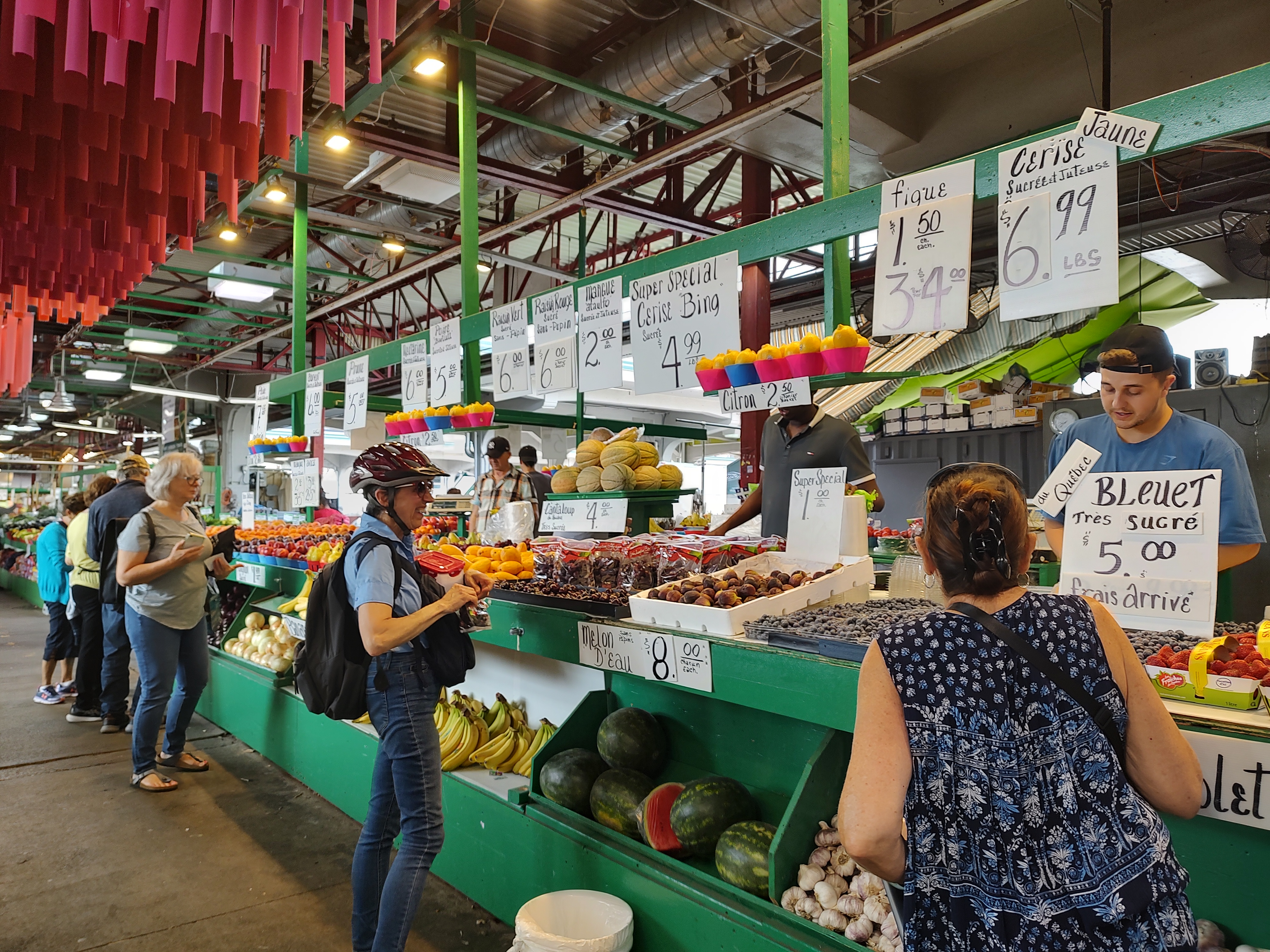
I go to Montreal to speak Italian and shop at an Italian grocery store.

And this year, I got to do both when I visited the Francophile Canadian city, while also writing about it! 

Call me an Italophile in French-speaking Montreal, and a grateful traveler whenever I can get there, which is now more often since I live in New England (the gateway to Montreal, in my opinion).

The post-war period saw a surge of Italian immigration to Canada such that the Italian community is slightly less assimilated there -- or slightly better at keeping traditions -- than in the States, and the culture a little more intact than in say New York's Little Italy. Plus, Montreal has had to fight for its Francophone existence in the wider sea of Canada’s English speakers, and now sees the value in safeguarding other cultures, including their languages. So a stroll through Little Italy ("Petite Italie") is often an occasion for Italian language practice.

At a bakery across the street from the Jean Talon market, a young cashier immediately switched to Italian when he saw my shirt, which had an image of the iconic Italian coffee pot called the Moka. His grandfather was from Puglia, in Southern Italy, he told me, and he learned to speak fluent Italian as a child.

As one person in Montreal told me, "We all speak three languages."

Little did I know when I visited as a child that Montreal would eventually become one of my kindred spots (assuming that places can be kindred spirits in the way people can -- sure feels like it).

Tuesday, December 12, 2023

What I read in 2023 & what I plan to read in 2024

(UPDATED) I had a special mission this year to immerse myself in Holocaust narrative so I could find a publisher for the short stories I am translating, thanks to an NEA literature grant. Of course, I've been reading Holocaust narrative from the moment I began translating Bruck's work. Well, actually, before that, really, because as soon as I read Primo Levi's first book (If This Is A Man), I understood that this was seminal information -- and I read it in college.

(The collection of short stories by Edith Bruck that I translated has been published: This Darkness Will Never End -- please check it out here or here!)

But I think in 2023, this particular strand of my reading life came into focus: I will never know enough about the Holocaust or World War II, and so I am going to keep studying it until the end of time.

What's stunning: the horror never receded. What Holocaust victims and survivors endured is unthinkable. No passage of time can diminish the pure horror of what they experienced. And it's remarkable -- though that word fails -- how varied survivors' experiences are -- in other words, how many horrific ways Nazis and others found to torment these poor people. So I keep reading (especially accounts by or about women survivors).

I wasn't especially productive, if my aim was to read a lot of books in full. Instead, I read parts of many books. But as I said, the reading I did about World War II and the Holocaust was seminal.

And so I will begin with books in that category:

Holocaust narrative or fiction based on the Holocaust

*L'esile filo della memoria, Lidia Beccaria Rolfi (This book begins a few days before the writer was liberated from the concentration camp called Ravensbruck, which is fascinating because it deals with the saga of afterward. As if the saga of before -- the camps -- weren't enough.)

*Cinque Storie Ferraresi by Giorgio Bassani

*Here in Our Auschwitz, Tadeusz Borowski 

*A Scrap of Time, Ida Fink (a collection of stories that includes "The Key Game" -- devastating)

*Return to Latvia, Marina Jarre (for a review)

*I'd Like to Say Sorry, but There's No One to Say Sorry To, Mikolaj Grynberg

*Women in the Holocaust, edited by Dalia Ofer and Lenore J. Weitzman (I read this book as part of research for an article I published in the American Scholar about women Holocaust survivors)

Auschwitz and After by Charlotte Delbo (French resistance fighter)

The Parnas by Silvano Arieti

Art from the Ashes (anthology)

Against Forgetting (anthology)

I read other books, of course, though I don't think I broke any records for number of titles consumed. Here's a sampling of what I read: 

Children's books

I have fallen into a habit of auditioning a new genre each year. Last year, it was graphic novels (I also read one this year: Moi aussi je voulais l'emporter; it's by an author I discovered in Montreal). This year: children's books. Specifically by Kate DiCamillo:

*Because of Winn-Dixie

*The Miraculous Journey of Edward Tulane

I guess you could say I've been reading children's books since 2012 when Leo was born, but these two books I read on my own -- Leo didn't have any interest. And they were beautiful. If you are trying to keep some awful tragedy at bay, and not succumb to tears, don't read them. Otherwise, proceed.

(Note, I read these books thanks to an essay by Ann Patchett on the joys of reading DiCamillo's books, regardless of your age)

Department of re-reading

La strada che va in città, Natalia Ginzburg (I could re-read Ginzburg until the end of my days)

Voci della sera, Natalia Ginzburg

Come una rana d'inverno, Daniela Padoan (interviews with three women who survived the Holocaust)

Books I perused (do they count?!)

Harry Potter and the Chamber of Secrets -- IN ITALIAN! (From Rizzoli and technically belonging to Leo)

The Pentagon Papers (because Daniel Ellsberg died this year)

L’Art Presque perdu de ne rien faire, Dany Laferrière (as Montreal trip prep)

The bible in Italian (I've never read it in Italian, now have I? So I bought a copy last year)

Books that fell into my lap -- serendipity

Still Life (Fiction) (thanks to my cousin-in-law Stephanie)

Is That a Fish in Your Ear? Translation and the Meaning of Everything By David Bellos

Nonfiction

The Years, Annie Ernaux (The final line is a stunner: "Save something from the time where we will never be again." It captivated me so much I memorized the French version as well: "Sauver quelque chose du temps  l'on ne sera plus jamais.")

Strangers To Ourselves, Rachel Aviv

High Fidelity by Nick Hornby (in connection with West Hartford Reads, a library initiative)

Fever Pitch by Nick Hornby (in connection with West Hartford Reads, a library initiative)

The Faith of a Writer by Joyce Carol Oates

Other notables

The Ones Who Don't Say They Love YouMaurice Carlos Ruffin (Fiction/Short Stories)

Paris Stories, Mavis Gallant (Fiction/Short Stories)

Reporting Live, Lesley Stahl (memoir)

Scene of the Crime, Patrick Modiano (“…another memory from that time emerged into the light, like strange flowers floating to the surface of stagnant waters.” I wrote a review of it for a small literary magazine, which you can read by clicking on the title.)

What I plan to read in 2024

Another book by Annie Ernaux (Using this guide from the Nobel Prize folks to help me out: https://www.nobelprize.org/what-to-read-books-by-annie-ernaux/)

Whatever Patrick Modiano writes (in translation)

Something/anything by Montreal-born graphic novelist Julie Delporte

Emily Wilson's translation of The Odyssey (but I said this last year as well so we'll see)

L'Agnese va a morire

At the Mind's Limits

A Farm Life: Observations from Fields and Forests by my friend Daryln Brewer Hoffstot

Leftover from last year:

*The Letters of Alberto Moravia and Elsa Morante (Quando verrai saro’ quasi felice)
*Clint Smith's How the Word Is Passed
*The Friends of Eddie Coyle

What will you read? What do you think I should read? What did you read this year? Leave comments here or in the post on Facebook. You can see the genres I read -- Italian fiction and nonfiction, memoir, Holocaust narrative, et al -- so please make some suggestions! Or something from a completely different genre. 

Happy reading! And Happy New Year! And happy reading in the new year.

-30-

Thursday, December 07, 2023

The Year in Writing & Crying (2023)

I considered 2022 a terrible year in writing for me so I suppose 2023 couldn't help but be better.

As it turns out, 2023 was quite a year for publishing my writing but almost certainly one of the worst years for me personally. That means I am going to report what I accomplished but skip some of the editorializing and grandstanding that normally comes along with this task. Accomplishing a lot in the writing world doesn't bring anyone back from the dead.

It didn't keep me from writing about the dead -- but that was back before I knew those ranks would swell.

In any event, in brief, here's what I published:

For The Millions, I wrote an essay about reading my father's books in the wake of his death. It's called, "The Books that Made My Father":

https://themillions.com/2023/01/the-books-that-made-my-father.html

As I've mentioned, I always aim to land work in new journals (see below). I also sometimes want to deepen my relationship with a publication by publishing work in a different section. I was thrilled this year, for multiple reasons, to publish a book review in the Boston Globe of a book by the Italian author I am translating. The book, Lost Bread, which was translated by Gabriella Romani, revisits her childhood and, of course, the worst moment of her childhood: deportation by the Nazis.

I also managed to publish a scholarly essay (maybe scholar-ish, no footnotes and I didn't include any digs about other scholars) on what women writers can tell us about surviving the Holocaust. It's called "The Forgotten Writers of the Shoah," and it was published by the American Scholar in September. I began work on it when I had a short fellowship at the New York Public Library in 2021.

https://theamericanscholar.org/the-forgotten-writers-of-the-shoah/

Wednesday, November 29, 2023

How Italy Ruined My Life (sort of -- for The Millions)

The way Italian plunges me into an intoxication of sound and thought is something I've wanted to write about for a long time.

The way the Italian language is like a person in my life, "a twin who accompanies me everywhere -- for better or for worse," the way knowing a foreign tongue "confers a special passport" or how my attempts to convince Florentines I had mastered their language -- la lingua di Dante -- devolved into nothing short of high school hazing ... yes I've wanted to explore this topic for so long.

And now I have! Thanks to my editor, Sophia, at The Millions.

You can read the essay here:

https://themillions.com/2023/11/the-quiet-exhilaration-of-reading-in-italian.html

-30-

Saturday, September 23, 2023

What women Holocaust survivors can teach us

When I went to study at the New York Public Library in connection with a short fellowship I'd won, my intention was to study the author whose work I was translating (Edith Bruck). Sure, I planned to look at other analogous works in translation.

But I wasn't expecting to uncover a trove of information about how women's experiences of deportation and imprisonment by the Nazis differed from men's experiences -- and more importantly, differed from the accepted notion of the Lager in the public imagination.

What I mean is: what we know about concentration camps comes largely from the accounts of men, including authors I prize such as Primo Levi and Elie Wiesel.

Their stories are essential, of course, but so, too, are the stories of clandestine pregnancies in the Lager and the fates of so many children which hung on whether their mothers chose to save themselves or accepted dying along with their little ones (since children were typically slated for immediate elimination). 

The only universally known story of the Holocaust not penned by a man is The Diary of Anne Frank. But there is so much more we need to learn -- and as the number of living witnesses dwindles, there's no time to lose.

Please read more at the American Scholar:

https://theamericanscholar.org/the-forgotten-writers-of-the-shoah/

And thank you.

End of ORIGINAL POST here.

Adding: I've jotted down some titles for anyone who wants to begin exploring books by women survivors, specifically. Here's a link to that post:

https://ciambellina.blogspot.com/2024/01/women-holocaust-survivors-reading-list.html

-30-

Sunday, August 27, 2023

First Boston Globe book review pubbed -- YES!

Thrilled to land a book review in the Sunday Boston Globe!

I am a fan of the Globe's arts coverage and besides, it's not easy to find good places to publish book reviews these days that actually pay something.

Thrilled the topnotch art staff came up with a custom illustration that illuminated the book's theme with the signature image (for many Holocaust memoirs and related books) of barbed wire.

Here's hoping a lot of Boston Globe readers took my advice to heart and read the book. Lord knows, I read a lot of book reviews and don't ever get around to read the actual books!

The piece ran last month. I meant to post this sooner! Anyhoo, here's a link to the book review:

https://www.bostonglobe.com/2023/07/20/arts/edith-brucks-lost-bread-an-account-holocaust-its-aftermath-cruelty-continues-survivors-even-after-auschwitz-is-closed/

Monday, July 10, 2023

For your trip to Florence -- buonviaggio!

When my aunt and uncle embarked on a trip to Florence last year (after an absence of 40 years!), I realized I have slightly skimped on travel tips here on Ciambellina or in some cases not organized the posts with tips well so I am going to try to unite everything here in one post. Everything you -- my friend, my Ciambellina reader, my cousin, my uncle -- need to know in order to have a special trip to Florence, Italy (where I still live in my heart). You can thank Aunt Maureen and Uncle Pat!

Before I get to specific tips and itineraries, let me mount my linguistic soap box: learn some Italian before you go

Not to be nice or cosmopolitan, and not to improve the American image abroad (magari!). 

But rather because: speaking Italian with an Italian is one of life's special pleasures.

The other major bits of advice:

*Walk as much as possible

*Visit the main produce markets

*Have a ciambella (and bring a few back for me).

OK, sermon over.

Where to go

Assuming you will tick off the major sites listed in your guide book or online (the Duomo, the Uffizi, l'Accademia, San Marco, Cappella Brancacci, etc.), I will move onto advice about other attractions in Florence.

One of the main recommendations I want to make is: Visit the Villa and Giardino Bardini. Most people visit Boboli Gardens, which is quite lovely but I think the Bardini is even better. The gardens are gorgeous [terraced in some parts] and the views stunning. When I was in Florence last summer, our ticket somehow got us entry to both, though I don't know how you would visit both in one day and see everything. 

(Note, they are both on the other side of the river).

Also on the other side of the river: Forte Belvedere and Piazzale Michelangelo. I recommend walking to both, but have your walking shoes handy. Both sights are gorgeous, with views equally as gorgeous. There's likely some important historical note someone else could tell you about.

There are also specific corners of the city that I love. I'll start with piazzas: 

Piazzas I love (to walk through, to stroll through, to gaze at, to sit in)

Piazza Santo Spirito (there's often a market on in this square)

Piazza del Carmine

Piazza dei Ciompi

Piazza della Repubblica (now with a carousel)

Piazza della Signoria

Quirky neighborhoods

Piazza Torquato Tasso: Real people live in this neighborhood! Locals gather to play soccer in the park at the center of the piazza and you could go over to Al Tranvai if you wanted authentic but decidedly unfussy Florentine food.

Piazza Santo Spirito: Still where you might find artisan workshops, real Florentines and flourishes of the everyday dolce vita, though to be honest, overtourism is swallowing up these things, even here.

Santa Croce (or one quirky aspect of the neighborhood): the area across from the piazza and the church was originally settled by Etruscans and it's one of the few places in the city where roads curve. There are some tiny, hidden piazzas and viuzze here that are fun to discover.


Speaking of which...

Where to eat

I mentioned Trattoria Cammillo (Borgo San Iacopo, #57R) in a previous post about restaurants in Florence because it's a place that I like (and Beyonce also liked it!).

Cibreo is also good -- there are actually multiple Cibreo storefronts in the same basic area, depending on your budget (Via Andrea del Verrocchio #8R). Here are some other recommendations:

https://ciambellina.blogspot.com/2015/05/where-to-eat-in-florence-update.html

Note, a lot of the places I like are on the other side of the river and two are in Piazza Santo Spirito: Trattoria Casalinga and Borgo Antico. The piazza is also quite lovely (see above) and the church was my father's favorite (designed by Brunelleschi).

I also love Ristorante Caffe Italiano on my old street, Via della Vigna Vecchia.

Where to eat and shop for dinner

I really like going to the public produce markets in Florence and the two main ones in centro are the Mercato di San Lorenzo (by the station; it is the best-known) and the Mercato Sant'Ambrogio; this last one is where I did my shopping when I was an ex-pat. It is east of Santa Croce -- and has fantastic cheese, sliced meats, veggies, etc. 

The San Lorenzo produce market -- the main market -- is now a wonderful place to dine and shop. You have to wade through the outdoor flea market surrounding the market to reach it but it's worth it.

Not just where to eat but what

People rave about pasta but here's a secret: Italian sandwiches are divine. Note: in the Old Country, they are nothing like a sub or a hero. Freshly made and reflective of all the Italian culinary acumen we've come to expect in pasta dishes, the Italian sandwich you can buy at a bar is something not to miss. Antico Noe is one of the best places for sandwiches, and not only because it is literally tucked inside a medieval arch a half-mile from Piazza Santa Croce (with a view of a medieval tower I once lived atop, but that's neither here nor there).

Other highlights:

Crostini -- as an appetizer. In the event these are new to you: little toasted slices of bread with toppings, including chicken pate, freshly-chopped tomatoes, mushrooms, etc.

Prosciutto crudo -- I believe it's part of Italy's culinary patrimony and I am not joking. Salty, silky, delicious. I don't care if you're a vegetarian -- my Italian friends certainly didn't when I pretended to be one in college and they kept urging me to eat prosciutto! (Ma dai!)

Cinghiale -- Wild boar. It's used often as the main ingredient of an amazing pasta dish that I suggest you order: pappardelle al cinghiale. It's available everywhere!

Porcini mushrooms -- if they are in season

Fiori di zucca (zucchini flowers) -- fried or stuff

Italian pastries -- Forget gelato. The real treats in Italy are pastries. Look for bars that say 'produzione propria' (that means they make their own pastries) or head to a pasticceria.

(Also grab a chocolate bar at the supermercato/alimentari if it has whole nocciole in it -- the big nut at the center of the baci candies. Why have one nocciola when you can have an entire chocolate bar full of them?)

Where to walk...

In addition to "everywhere," I also recommend walking to the other side of the river -- often. From there, as I've mentioned, you can walk to Forte Belvedere, Piazzale Michelangelo and the Bardini gardens.

Indeed some of the nicest walks are in the area around San Niccolò (the other side of the river) because they allow you to get outside the walls of the city and go up into the hills. One place you could try walking to is Forte Belvedere.

Where to have a coffee and step onto a page of A Room With A View:

There are old-school caffes that make your morning coffee feel royal and four of them are on Piazza della Repubblica, of which Caffe Gilli is probably the best (coffee/pastries/aperitivo etc); also the Rivoire on Piazza della Signoria will make you feel as though you're a wealthy landowner.

Where to drink wine

Everywhere! That's one of the things that makes Italian coffee bars special -- you can order a caffe latte in the morning and un bicchiere di vino rosso in the evening!

But I will give one recommendation of a place to drink: Rose's on Via del Parione; it's on one of the more beautiful streets in the center city. Drink outside at one of the tiny tables where you can watch fancy Florentines walk and bike by.

Look for a place called 'enoteca' to sample some good wine. I also love the hole-in-the wall (literally) kiosks where you stand on the street at a counter and order a glass of wine and maybe a sandwich.

Pastries

You'll find an entry for gelato below but as I mentioned, I think paste or pasticcini [pastries] are the unsung sweets of Italian cities (unsung, I should say, by Americans. Italians know). And really, by now, you should know my favorite: la ciambella or ciambellina (looks like a donut if a donut was baked in God's kitchen). Also good: un bombolone (similar but without the hole and typically filled with crema). 

Gelato

Vivoli (Via Isola delle Stinche) around the corner from our old apartment is very popular and also very good but so is Festival del Gelato right off of Piazza della Repubblica (down the block from the Duomo). Also good (and popular): Gelateria Carraia and Gelateria Santa Trinita (both are stationed on the other side of two consecutive bridges across the River, Oltrarno side).

Souvenirs

I still buy souvenirs and so should you! I favor paper goods because reading in Italian is my passion (and paper was an ancient Florentine art) so my suitcase is always loaded down with novels and magazines but the category also includes notepads, calendars and the like, which would appeal to anyone.

I find some of the best souvenirs can be had at the big bookstore on Piazza della Repubblica: Libreria Feltrinelli (there are also lots of kiosks right in front of the bookstore that may have something you like). In addition, I highly recommending visiting the Bialetti store for the classic Italian Moka coffee pot (and coffee cups and other accessories).

Lastly, I know some of you out there are real foodies so I recommend checking out a website published by a local Florentine food writer who knows her stuff (and has Catholic interests -- hugely into sushi, etc.):

https://www.ioamofirenze.it/

She recently published a guide on her blog to choosing a restaurant in Florence:

https://www.ioamofirenze.it/mi-consigli-un-ristorante/

Note, it's in Italian but all the addresses you see everywhere (on maps, for hotels, etc) are in Italian anyway and the names of restaurants are in Italian on the sides of buildings so if you really want to go somewhere, you'll figure it out. I suggest choosing something from her guide under the category 'Trattorie tipiche' ('local, traditional eateries'), with the name of the restaurant in bold at the start of each entry (then Google the name of the restaurant and figure out where it is). She also has a heading for fine dining (in English) and if you have the euros, go for it!

Buonviaggio!

-30-